
If you've ever looked at an SEO report, you've probably seen a number labeled "Domain Rating" or "DR." Maybe someone told you yours is too low. Maybe a link-building service promised to raise it. Before you spend any money, let's get clear on what this number actually means.
What Domain Rating actually measures
Domain Rating is a metric created by Ahrefs (one of the most widely used SEO tools) that scores your website's backlink profile strength on a scale from 0 to 100. It measures one thing: how strong the collection of links pointing to your domain is compared to every other domain in Ahrefs' database.
DR 0 means essentially no backlinks. DR 100 means you're among the most linked-to sites on the internet (think Google, YouTube, Facebook).
Important distinction: DR is an Ahrefs metric, not a Google metric. Google does not use Domain Rating in its ranking algorithm. Google has its own internal systems for evaluating link profiles, and those systems don't produce a single public number.
DR vs. Domain Authority vs. Page Authority
These terms get thrown around interchangeably. They shouldn't be.
Domain Rating (DR): Ahrefs metric. Measures backlink profile strength at the domain level. Scale 0 to 100.
Domain Authority (DA): Moz metric. Similar concept but different calculation. Also 0 to 100. Moz and Ahrefs often produce different scores for the same site because their databases and algorithms differ.
Page Authority (PA): Moz metric that scores individual pages rather than entire domains. A single page can have high PA on a low-DA site if that specific page earned strong links.
PageRank: Google's original algorithm for measuring link value. Still exists internally but Google retired the public PageRank Toolbar in April 2016 (with scores last updated in December 2013). It works at the page level, not the domain level.
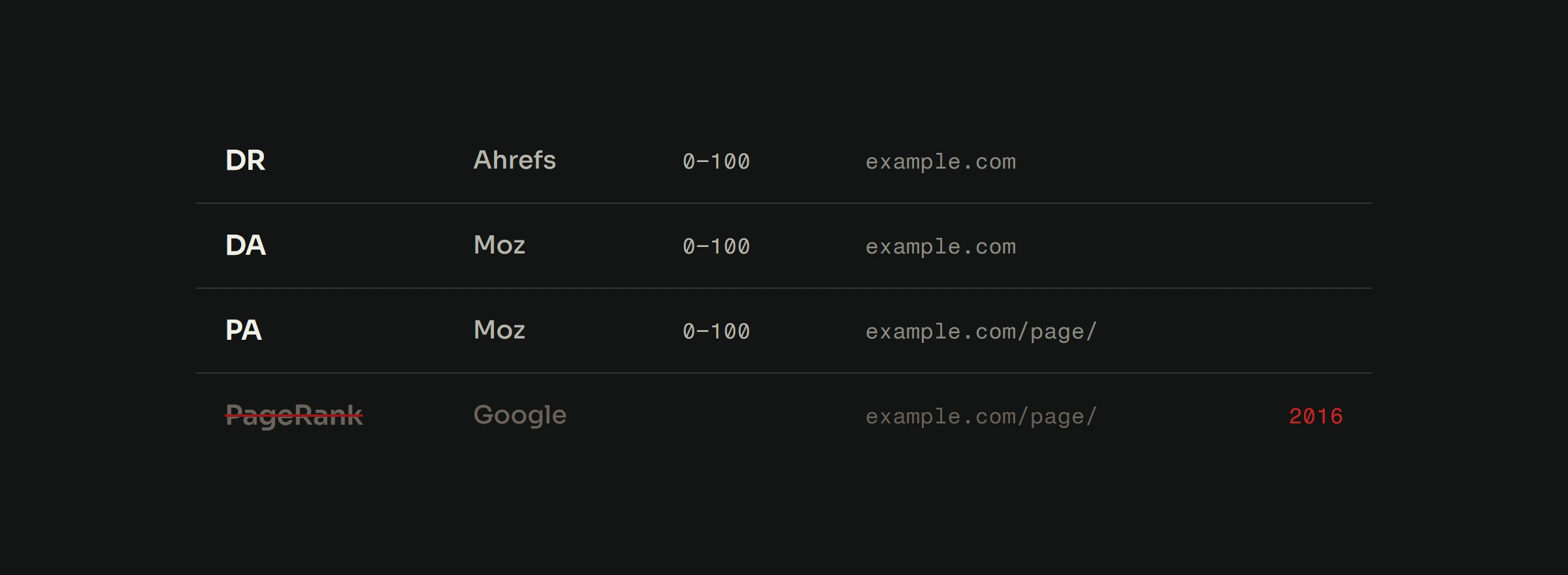
None of these metrics are used directly by Google for rankings. They're third-party approximations. Useful for comparison and trend-tracking, but not gospel.
How Domain Rating is calculated
Ahrefs calculates DR based on three main factors:
Number of unique referring domains. How many distinct websites link to you. One link from 100 different sites matters more than 100 links from one site.
Authority of those linking domains. Links from high-DR sites pass more value than links from low-DR sites. A single link from a DR 80 news site can impact your DR more than 50 links from DR 10 blogs.
How many other sites those domains link to. If a DR 90 site links to you but also links to 50,000 other sites, each individual link carries less weight. This is sometimes called "link equity distribution."
DR uses a logarithmic scale. Moving from DR 20 to 30 is significantly easier than moving from 70 to 80. The higher you go, the more backlinks you need for each point increase.
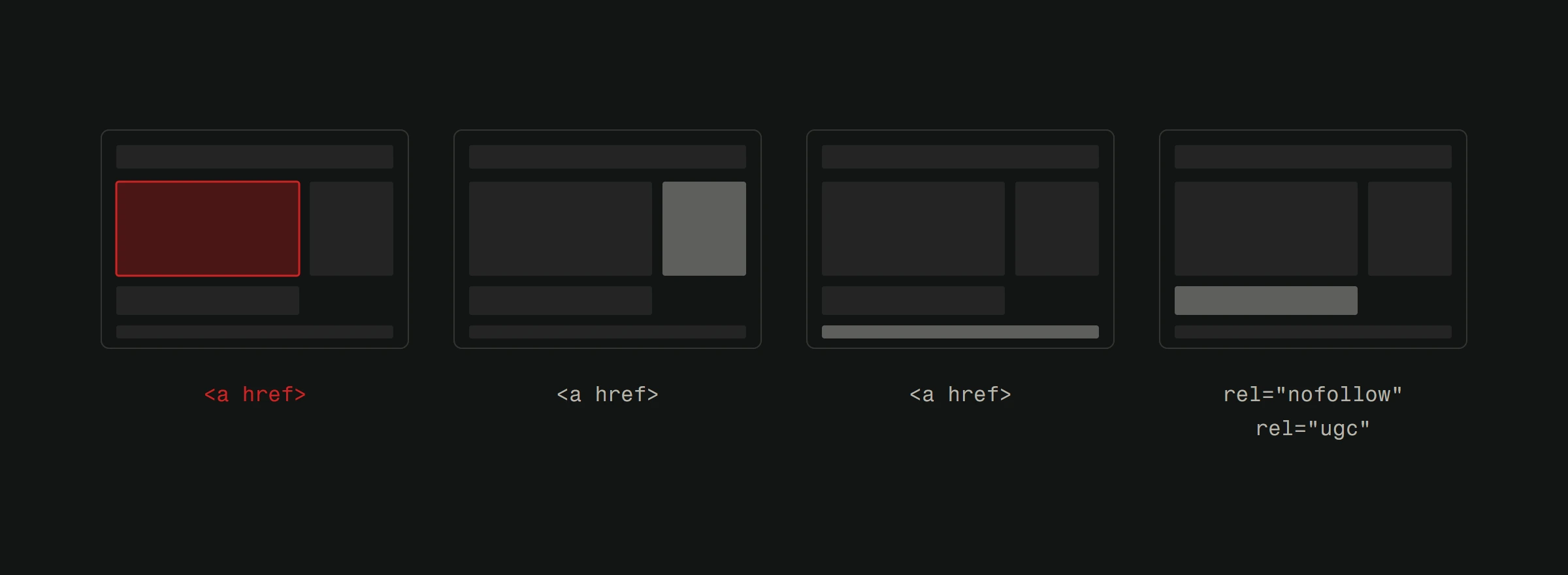
Note: In September 2025, Ahrefs rolled out a major algorithm update that recalibrated both DR and URL Rating (UR). The update reduced the influence of low-quality referring domains, added stricter differentiation between dofollow/nofollow/UGC/sponsored links, and improved detection of manipulative linking. Many sites saw their DR drop by 6-10+ points overnight without any actual change to their backlink profile. If your DR dropped around that time, this is likely why.
What's a good Domain Rating?
This depends entirely on your industry and competitive landscape. There's no universal "good" number.
DR 0 to 10: New sites or sites with virtually no backlinks. Common for small local businesses that haven't done any link building.
DR 10 to 30: Established sites with some backlinks. Typical for small to medium businesses with a basic online presence.
DR 30 to 50: Sites with a solid backlink profile. Competitive for many local and niche markets. Most small businesses should aim to reach this range.
DR 50 to 70: Strong authority. Major regional businesses, popular blogs, established brands.
DR 70+: Major publications, large corporations, viral websites. Getting here requires years of work or massive brand recognition.
For a local business in Croatia, a DR of 25 to 40 is usually enough to compete effectively in local search results. Chasing DR 70 isn't realistic or necessary. If reaching the first page is your main objective, our post on 5 practical tips to reach Google's first page covers what actually moves the needle beyond DR alone.
Why DR matters (and why it doesn't)
DR matters as a relative benchmark. It helps you:
- Compare yourself to competitors. If competing sites have DR 40 and you're at DR 15, you have a backlink gap to close.
- Evaluate potential link sources. When pursuing backlinks, DR helps you prioritize. A link from a DR 60 site is worth pursuing. A link from a DR 5 site probably isn't.
- Track progress over time. Watching your DR trend upward confirms your link-building efforts are working.
DR doesn't matter as an absolute score. Don't obsess over the number itself. A DR 25 site with highly relevant, niche-specific backlinks can outrank a DR 50 site with random, irrelevant links for specific queries. Relevance matters as much as authority.
Google cares about the quality, relevance, and naturalness of your link profile. Not your Ahrefs score.
How to improve your Domain Rating
Since DR is based on backlinks, improving it means earning better links. Here are the methods that actually work.
Create linkable content
Nobody links to your services page. They link to content that helps them, entertains them, or provides data they can reference.
Content types that earn links: original research, industry surveys, free tools, comprehensive guides, infographics with original data, and controversial (but defensible) opinion pieces.
Guest posting on relevant sites
Write articles for websites in your industry or region. Not for spammy "guest post farms" but for legitimate publications your audience actually reads. Each published article typically includes a link back to your site.
Focus on relevance over DR. A link from a DR 30 site in your exact industry is often more valuable than a link from a DR 60 site about an unrelated topic.
Digital PR and outreach
Create something newsworthy and pitch it to journalists and bloggers. Local data ("We analyzed 500 Croatian business websites and found that 72% load slower than Google recommends") gets picked up by local media. That earns real editorial links.
Fix broken link opportunities
Use Ahrefs or similar tools to find broken links on other websites that point to content similar to yours. Contact the site owner, let them know about the broken link, and suggest your content as a replacement. This works because you're solving their problem while earning a link.
Clean up toxic links
Not all links help. Spammy, irrelevant, or manipulative links can harm your profile. Regularly audit your backlinks using Ahrefs or Google Search Console. Disavow truly toxic links through Google's Disavow Tool.
Common DR myths
"Higher DR means higher rankings." Not directly. DR correlates with rankings because strong backlink profiles help rankings. But DR itself isn't a ranking signal.
"You can buy a high DR." You can buy links, but Google actively penalizes purchased links. The short-term DR boost isn't worth the long-term ranking damage.
"DR changes quickly." DR typically moves slowly. Expect months of consistent link building before seeing significant changes. Anyone promising rapid DR increases is likely using tactics that will hurt you later.
"My DR dropped, so I'll lose rankings." DR fluctuates as Ahrefs updates its database and refines its algorithm (a major recalibration in September 2025 caused widespread drops). A drop doesn't necessarily mean you lost links or that your rankings will change. Check your actual backlink count and your Google Search Console traffic data before worrying.
How DR fits into your overall SEO strategy
Domain Rating is one metric among many. It's useful but not the most important thing to track.
More important metrics: organic traffic trends, keyword rankings for your target terms, conversion rates from organic traffic, and Core Web Vitals scores. These directly reflect business results. DR is a leading indicator that your link profile is growing, but it's not the end goal. As SEO itself continues to change, understanding the evolution of SEO helps you put metrics like DR in the right context.
If you want to understand how your backlink profile compares to competitors and where the opportunities are, our SEO service includes competitive backlink analysis as part of the process.
A domain rating is a third-party estimate. What you control is your own site, and that's what our free website analysis looks at: a developer goes through your site by hand and sends back what to fix first, ranked by impact, within 48 hours.