
Go look at your product descriptions right now. If they read like a manufacturer's data sheet, you are leaving money on the table.
Most online stores treat product descriptions as an afterthought. A title, a few bullet points copied from the supplier, maybe a size chart. Done. But here is the thing: when someone cannot touch, hold, or try your product, your description is doing the selling. It is your sales floor, your packaging, and your salesperson all in one block of text.
Great product descriptions do not just describe. They persuade.
Sell the benefit, not the feature
This is the oldest copywriting advice in the book, and most e-commerce stores still get it wrong.
A feature is what the product is. A benefit is what it does for the buyer. Nobody cares that your jacket has "200g synthetic insulation." They care that they will stay warm on a freezing January morning without wearing three layers.
For every feature you list, ask yourself: "So what? Why does this matter to the person buying it?" That answer is your benefit. Lead with it.
Feature: 10,000 mAh battery capacity. Benefit: Enough power to charge your phone three times over. Take a weekend trip without packing a cable.
See the difference? One is a spec. The other is a picture of someone's life getting easier.
Write like a human, not a catalog
Read your product descriptions out loud. If they sound like they were written by a robot or a legal department, start over.
Good product copy sounds like a knowledgeable friend recommending something. It is conversational but credible. It uses "you" more than "we." It speaks directly to the buyer's situation.
That does not mean being sloppy or unprofessional. It means dropping the stiff corporate tone that makes every product sound the same. Your brand has a voice. Use it in your descriptions too.
Structure for scanners
People shopping online do not read product pages top to bottom. They scan. Their eyes jump to bold text, bullet points, and anything that stands out visually.
Structure your descriptions to work with this behavior:
Lead with a hook. One or two sentences that capture why this product matters. Not the full story. Just enough to make someone keep reading.
Use bullet points for specs. Dimensions, materials, compatibility, what is included in the box. Put these in a scannable list so people can find what they need fast.
Write a short narrative paragraph. This is where you paint the picture. Describe the experience of using the product. Who is it for? What problem does it solve? How does it feel?
Add a clear call to action. Do not assume people will figure out the next step. Tell them to add it to their cart.
This structure works whether you are running a custom-built store or any other e-commerce platform. The principle is the same.
SEO is not optional
Your product descriptions are landing pages. People search for products on Google, and your description is what determines whether they find you.
Include the keyword naturally. Whatever someone would type into Google to find this product, that phrase should appear in your title, your description, and your URL. But it should read naturally. Do not force it.
Write unique descriptions. If you are using the manufacturer's stock copy, so is every other store selling the same product. Google does not want to rank five identical pages. Write your own version and you immediately stand out.
Think about long-tail keywords. "Running shoes" is competitive. "Lightweight trail running shoes for wide feet" is specific enough to rank and attracts someone who knows exactly what they want. That person is much closer to buying.
If you want to understand the fundamentals, our guide on what SEO optimization is breaks it all down.
Make it easy to say yes
Every product description should reduce friction. Remove the reasons people hesitate.
Answer common questions in the description. If people always ask about sizing, include a sizing note. If the most common concern is durability, address it upfront. Do not make them hunt for answers.
Use social proof where possible. A short mention of how many units have been sold, a customer quote, or a "bestseller" tag adds credibility. People buy what other people buy.
Be honest about limitations. If the product is not for everyone, say so. "This bag is designed for ultralight backpackers. If you need to carry more than 10kg, look at our Summit series." That kind of honesty builds more trust than pretending every product is perfect.
Common mistakes that kill conversions
Copying the manufacturer description. Duplicate content hurts your SEO and says nothing your competitors are not already saying.
Writing a novel. Product descriptions should be thorough but not long-winded. Get to the point. Respect the buyer's time.
Ignoring mobile. Over 75% of e-commerce traffic now comes from mobile devices. If your description is a wall of text on a phone screen, people leave. Short paragraphs and bullet points are not optional.
Forgetting the emotional angle. People make buying decisions emotionally and justify them logically. A purely rational description misses half the equation.
AI tools are not a shortcut
AI can draft product descriptions fast. Tools exist that generate hundreds of descriptions from a spreadsheet of specs. And the output is getting better every year.
But here is the reality: AI-generated descriptions without human editing read like AI-generated descriptions. They hit the right keywords but miss the voice. They cover the specs but skip the emotion. They are functional but forgettable.
Use AI to accelerate your workflow if you have hundreds of SKUs. But always edit the output to match your brand voice, add real-world usage context, and inject the kind of specific detail that only someone who knows the product can write. A hybrid approach (AI draft plus human polish) gets you speed without sacrificing quality.
Do not skip structured data
Here is something most store owners overlook entirely: Product schema markup. This is structured data you add to your product pages so search engines understand exactly what you are selling, its price, availability, brand, and condition.
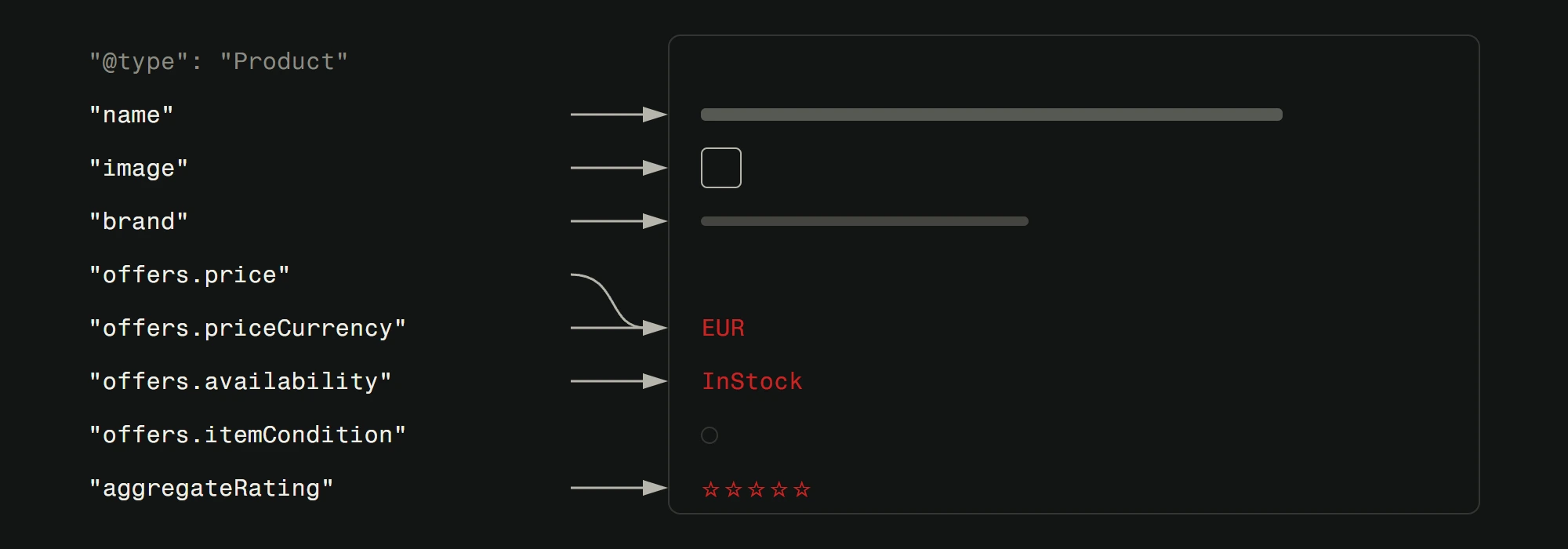
Without it, Google is guessing. With it, your products can appear in rich results with star ratings, prices, and stock status directly in the search results. Pages with complete Product schema markup see significantly higher click-through rates and are far more likely to appear in Google Shopping results and AI-powered shopping answers.
If your e-commerce platform does not handle this automatically, make it a priority. It is one of the highest-impact technical SEO moves you can make for a product page.
The difference a good description makes
We have seen the difference between a web store and a web shop come down to details like this. Two stores selling the exact same product at the exact same price. One has flat, generic descriptions. The other has descriptions that speak directly to the buyer. The second store wins every time. Every product description should be written to do two jobs: help the customer decide and help Google understand the page.
Your products deserve descriptions that work as hard as you do. Take the time to write them well, and you will see it in your conversion rates.
Want an online store where great products meet great copy? See how we build e-commerce sites that are designed to sell.