Traditional SEO is about showing up when people search. Google Discover flips that entirely. It shows your content to people before they search, based on what Google thinks they'll find interesting.
Over 800 million people see the Discover feed every month. It appears in the Google app, on Chrome's mobile homepage, and at google.com on phones. When your content lands in someone's Discover feed, the traffic spike can be massive. We're talking 10x your normal daily traffic from a single article.
The best part: you don't pay for it. The hard part: you can't force it. But you can stack the odds heavily in your favor.
How Google Discover actually works
Discover is a personalized content feed. Google's algorithms analyze each user's search history, location, language preferences, browsing behavior, and past interactions with Discover content to predict what they'll want to read next.
This is fundamentally different from search SEO. With search, you're matching content to a query. With Discover, you're matching content to a person's interests. There's no keyword someone types in. Google decides your content fits a user's profile and shows it to them.
What Google looks for
Content freshness. Discover heavily favors recently published or updated content. Evergreen articles can appear, but new content about trending topics has a significant advantage.
E-E-A-T signals. Experience, Expertise, Authoritativeness, and Trustworthiness. Google wants to show content from sources it trusts. Sites with strong domain authority, clear authorship, and a track record of quality content get favored. Google's February 2026 Discover Core Update further strengthened this: expertise is now evaluated per topic, not site-wide, so consistent depth in your niche matters more than general authority.
Engagement potential. If Google predicts users will spend time with your content (not just click and bounce), it's more likely to show it. This means your content needs to actually deliver on what the headline promises.
Visual appeal. Discover is a visual feed. Articles with compelling, high-quality images get significantly more impressions and clicks than those without.
Optimizing your content for Discover
Get your images right
This is non-negotiable. Discover is a visually-driven feed, and your image is the first thing users see.
Requirements:
- Minimum 1200 pixels wide.
- Aspect ratio of 16:9 or 4:3.
- Original photos outperform stock images consistently.
- Images should be relevant to the article, not decorative filler.
- Faces and recognizable locations tend to get higher engagement.
Add the max-image-preview:large meta tag to your pages. Without it, Google may not show your images in Discover at full size, which kills your click-through rate.
Write headlines that earn clicks (not tricks)
Your headline is competing for attention in a feed alongside news, entertainment, and content from major publishers. It needs to be compelling.
What works:
- Specific numbers: "7 ways to..." performs better than "several ways to..."
- Clear benefit: Tell readers exactly what they'll get.
- Curiosity without deception: Make people want to click, but deliver on the promise.
- 50-60 characters: Longer headlines get truncated on mobile.
What doesn't work:
- Pure clickbait. Google's systems are good at detecting headlines that overpromise and underdeliver. If users consistently bounce after clicking, your Discover visibility drops.
- Vague headlines. "You won't believe what happened" tells the algorithm nothing about the content's relevance.
Depth over breadth
Shallow articles rarely appear in Discover. Google has enough surface-level content to choose from. What it lacks is thorough, well-researched pieces that genuinely satisfy reader curiosity.
Aim for at least 1,000 words. Not because length itself matters, but because it's hard to cover a topic thoroughly in fewer words. Back up claims with data. Include specific examples. Share original perspective. This is what separates Discover-worthy content from forgettable content.
For tips on writing content that performs, see our guide to SEO blog writing.
Technical requirements
Core Web Vitals
Google Discover prioritizes pages that load fast and display correctly. Your Core Web Vitals targets:
- LCP (Largest Contentful Paint): Under 2.5 seconds.
- CLS (Cumulative Layout Shift): Under 0.1.
- INP (Interaction to Next Paint): Under 200 milliseconds.
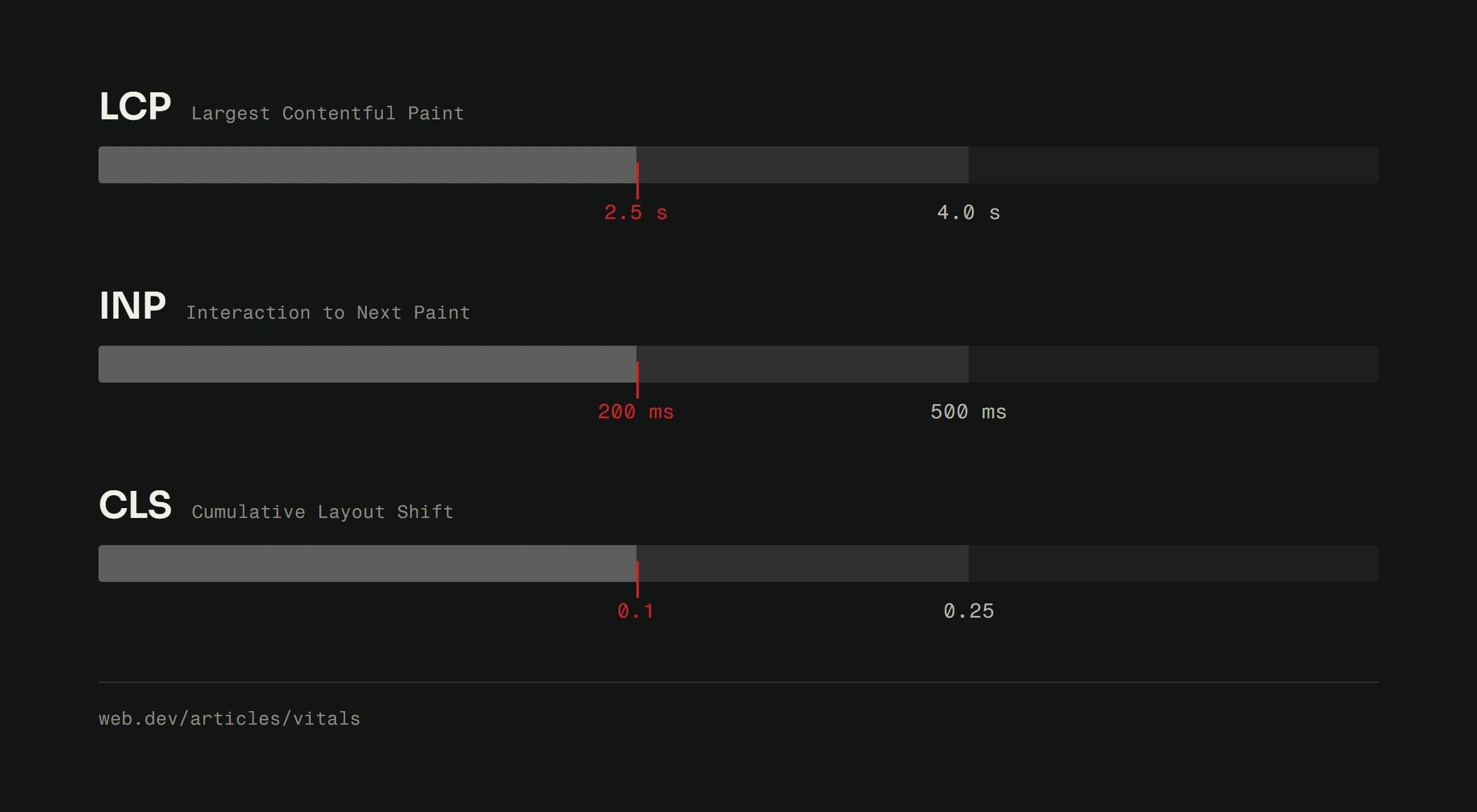
If your site is slow, Discover won't show your content no matter how good it is. Fix speed issues first. Our site speed guide covers the practical fixes.
Structured data
Implement Article schema markup on all blog posts. This helps Google understand your content's structure, authorship, and publication date. All of these feed into Discover's content selection.
At minimum, include:
headlineauthordatePublisheddateModifiedimage
Mobile experience
Discover is almost entirely a mobile experience. If your site isn't excellent on mobile, you're disqualified before the algorithm even considers your content.
Test on real devices. Check that text is readable without zooming, buttons are easily tappable, and the page doesn't jump around while loading. More on this in our responsive design guide.
Content strategies that get Discover traffic
Combine evergreen value with timely angles
An article titled "How to optimize your website" is evergreen but not timely. "How Google's 2025 updates change website optimization" is both. Discover's algorithm responds strongly to content that connects lasting value with current relevance.
Keep an eye on Google Trends for your industry. When you spot a rising topic, be one of the first to publish a thorough piece on it.
Local content with broad appeal
For businesses targeting the Croatian market, content about local topics with universal principles performs well. Write about local business challenges, regional market trends, or case studies from your area.
Google Discover factors in location heavily. The February 2026 Discover Core Update made geographic relevance a stronger signal: users in Croatia are now even more likely to see content from Croatian publishers, while content from outside their region gets deprioritized. This is a significant advantage for local publishers.
Publish consistently
Sporadic publishing hurts your Discover performance. Google favors publishers with a consistent track record. That doesn't mean daily. It means predictable.
Set a realistic schedule you can maintain. Two quality articles per week is better than seven rushed ones. Consistency signals to Google that you're a reliable source worth recommending.
Measuring your Discover performance
Google Search Console
Open Google Search Console and navigate to the "Discover" report under Performance. This shows:
- Total impressions (how many times your content appeared in feeds).
- Clicks (how many people tapped through).
- CTR (click-through rate, which tells you how compelling your headlines and images are).
If you don't see a Discover tab, your site hasn't received enough Discover traffic yet. Keep optimizing and it will appear once you start getting consistent impressions.
What the data tells you
Look for patterns in your successful Discover content:
- Which topics perform best?
- What headlines get the highest CTR?
- What type of images correlate with more impressions?
- Which articles had the longest traffic spike?
Use these insights to refine your content strategy. Double down on what works. Drop what doesn't.
Common mistakes that kill Discover visibility
Clickbait headlines that don't deliver. Google tracks whether users engage with your content after clicking. High bounce rates signal that your headline overpromised. This tanks future Discover visibility.
Low-quality or missing images. No image, small image, or generic stock photo means your article gets overlooked in a visual feed.
Thin content. A 300-word article won't cut it. Discover shows content Google is confident will satisfy users. Brief, superficial pieces don't inspire that confidence.
Ignoring mobile performance. If your page loads slowly or looks bad on a phone, Discover won't show it. Period.
Inconsistent publishing. Publishing 10 articles one week and nothing for the next month confuses the algorithm about your reliability as a source.
Is Discover worth the effort?
Yes, with a caveat. Discover traffic is volatile. You might get 10,000 visits from one article and 200 from the next. It's not a reliable, steady stream like organic search traffic.
But the effort you put into Discover optimization (quality content, strong images, fast site, mobile-friendly design) also improves your regular SEO performance. You're not optimizing for Discover instead of search. You're doing the same work that benefits both channels.
Think of Discover as a bonus. Build your SEO foundation first. Discover traffic is the upside that comes from doing everything else right.
Want to know if your site is Discover-ready? Start with a free website analysis and we'll assess your technical foundation, content quality, and optimization opportunities.