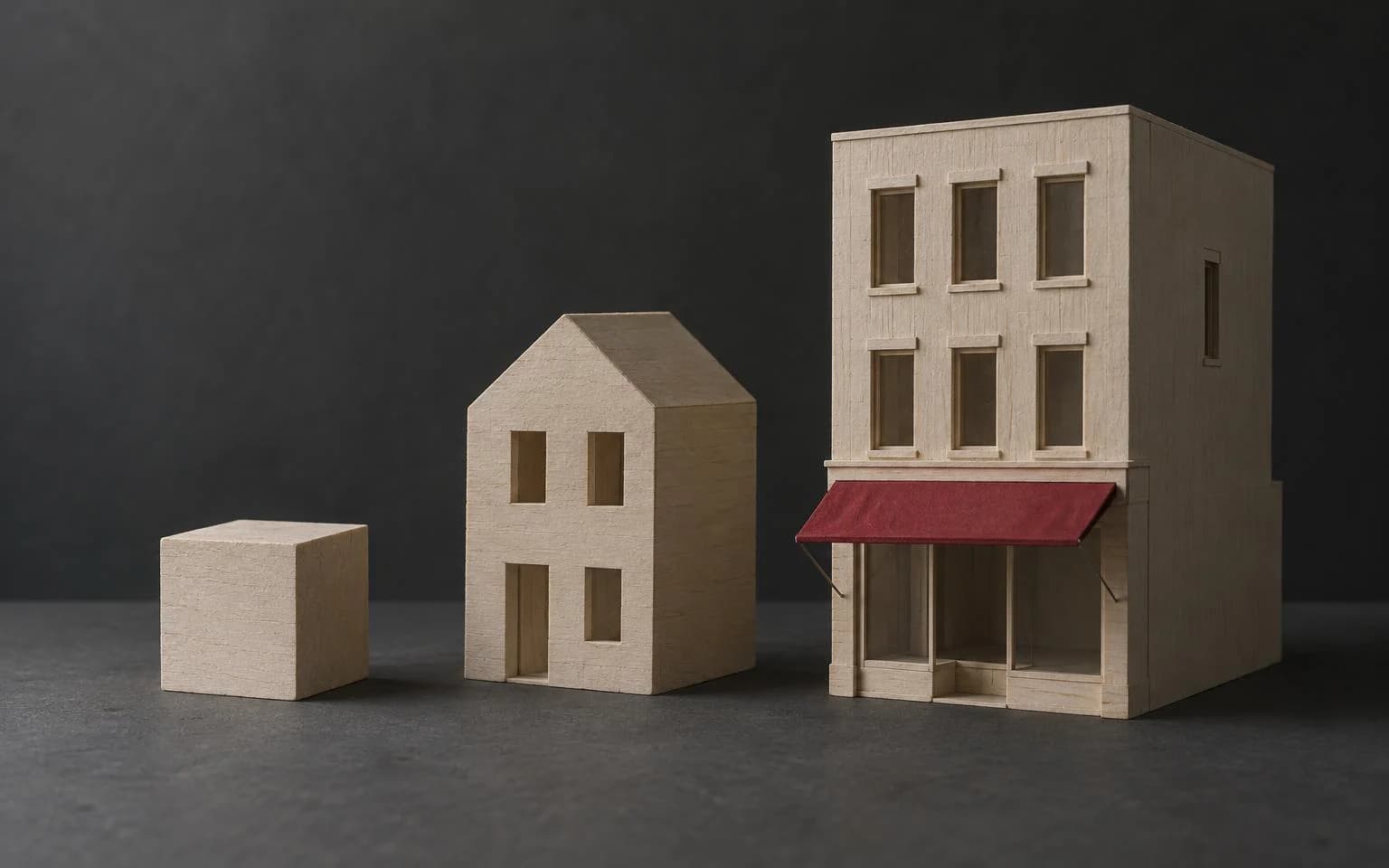
The short answer: web store, web shop, webshop and online store all describe the same thing, a site where a customer picks a product, pays and gets an order confirmation. EU law tends to call it "e-commerce", and in everyday speech the terms are used interchangeably.
The difference worth knowing isn't in the name, it's in the scope. Some shops only sell. Others also explain, compare and guide the buyer towards a decision. Here's what that means in practice, which one you need, and what every online shop selling to consumers in the EU has to have in 2026.
What's a web shop?
A web shop is focused. It does one thing well: it sells products online.
A customer arrives, browses, picks what they want, pays and leaves. Everything is arranged around the purchase, with as few steps as possible between "I want this" and "I bought this". A typical web shop has a product list, a cart, checkout and payment processing. That's the core, and everything else is secondary.
The model suits small businesses with a clear range. A bakery selling its own products, a maker with thirty handmade items or a wine shop that delivers doesn't need a large content operation. They need a clean, fast way to get their products online.
The strength of a web shop is simplicity. There are fewer pages to maintain, it's quicker to build, and customers can see straight away how to buy.
What's a web store?
A web store is a web shop that also builds content around its products.
It still sells, but it surrounds the purchase with detailed descriptions, comparisons, reviews, buying guides, videos and recommendations, all there to help the customer decide. That model makes sense for large catalogues, complex products and markets where buyers compare for a long time before they buy, such as electronics, equipment or B2B purchasing.
The price is complexity. There are more pages, more content someone has to write and keep current, and more features to build and maintain.
The differences side by side
| Web shop | Web store | |
|---|---|---|
| Range | focused, tens to a few hundred products | large catalogue with categories and collections |
| Content | product descriptions | descriptions, guides, comparisons, blog, video |
| Customer | usually knows what they want | compares and comes back several times |
| Search | found through product pages | found through product pages and content |
| Upkeep | product and price updates | the same, plus ongoing content work |
Range. A focused catalogue runs on one product template, so a hundred products isn't a hundred pages of work. A web store adds guides, comparisons and collections, and each of those is a new layout someone has to design.
Content and search. Good product descriptions are enough for a web shop. A web store invests in pages that answer buyers' questions, like "how to choose running shoes", which gives people more ways to find it on Google. For a closer look at search for online shops, see our SEO services.
Technology. A web shop usually runs on a standard platform like WooCommerce or Shopify. A web store more often needs connections to inventory, a CRM, email and analytics.
Which one do you need?
It depends on your business, not on which name sounds bigger.
A web shop is a good fit if:
- your range is focused and customers mostly know what they're looking for,
- you want to start selling soon,
- your products are easy to explain,
- you'd rather start with a smaller investment.
A web store is a good fit if:
- your catalogue is large or growing,
- your products need explanation, comparison or advice,
- you want search content to bring in buyers,
- someone on your side will write and update that content.
Most small businesses start well with a web shop and add web store elements when there's a reason to: reviews first, then guides, later comparisons and recommendations. That keeps the initial build cost reasonable while the foundation is ready for growth. It's why the platform and the CMS you choose at the start matter. Once the shop is live, the next step is bringing in customers, which our guide on how to advertise your web shop covers.
What an online shop in the EU must have in 2026
Whatever you call it, a shop selling to consumers in the EU picked up new obligations over the last two years. This is an overview, not legal advice, so check your own situation with an accountant or lawyer.
A withdrawal function. From 19 June 2026, contracts concluded through a website must come with an easy-to-find withdrawal function, usually a button or a link in the footer, so consumers can withdraw as easily as they bought (Directive (EU) 2023/2673, which member states apply from that date).
Accessibility. The European Accessibility Act has applied since 28 June 2025 and covers e-commerce services. Your shop and its checkout must work for people with disabilities, for example with a screen reader or a keyboard alone. Microenterprises providing services, those with fewer than ten staff and up to €2 million in annual turnover, are exempt (Directive (EU) 2019/882, Article 4(5)).
Product and manufacturer details. Since 13 December 2024, every product offered online must clearly show the manufacturer's name, postal and email address, a responsible person in the EU if the manufacturer is outside it, information identifying the product including a picture, and any warnings or safety information (General Product Safety Regulation (EU) 2023/988, Article 19).
Fiscalised receipts in Croatia. If you sell in Croatia, every receipt to a consumer has been fiscalised since 1 January 2026, whatever the payment method, card and bank transfer included. Distance sales to consumers in other EU countries under the OSS scheme are not fiscalised in Croatia (Croatian Tax Administration, updated 7 October 2026).
Security of the shop itself. A shop on WooCommerce or another PHP-based system needs current PHP, plugins and themes. PHP 8.2 stops receiving security fixes on 31 December 2026 (php.net, supported versions), and current plugins and themes close the flaws already published for them. What we do there is on our cybersecurity for websites and web shops page.
What matters more than the label
Your customers don't care whether you call it a web shop or a web store. They care whether they can find a product quickly, whether paying is easy, whether the site loads fast on their phone and whether the return policy is easy to find.
Get those fundamentals right and the label stops mattering. User experience beats terminology every time.
Planning an online shop and not sure which way to go? We build both simple shops and content-rich stores. See what our website and web shop builds include.