Why Website Speed Matters More Than You Think

A slow website kills your search rankings, tanks conversions, and drives customers to competitors. Here is why speed is the foundation of everything else.

Here is a number that should keep you up at night. 53% of mobile visitors abandon a site if it takes longer than three seconds to load. Not ten seconds. Not five. Three.

That means your slow website is not just annoying people. It is actively sending more than half your potential customers to your competitors. Before they have seen your product. Before they have read a single word. Gone.

Speed is not a technical detail to handle later. It is the most important feature your website has.

The User Does Not Wait

People have been trained by fast apps and instant search results to expect immediacy. When your site loads slowly, you are not just testing their patience. You are breaking an implicit promise.

A two-second load time feels fast. A three-second load time feels normal. A four-second load time feels slow. A five-second load time feels broken. These are not opinions. They are consistent findings across user research studies over the past decade.

The psychological effect goes deeper than frustration. A slow site makes your entire business feel less competent. If you cannot make a website load quickly, the user thinks, what else are you bad at? Speed is a trust signal. Slowness is a warning sign.

And users do not give second chances. If someone bounces from your site because it was slow, they are unlikely to try again. Their next click goes to a competitor whose site loaded instantly. You do not just lose that visit. You lose that customer.

Google Cares About Speed. A Lot.

Page speed has been an official Google ranking factor since 2010. Core Web Vitals, introduced in 2021, made it even more explicit. Google does not hide this. They publish the metrics and the thresholds.

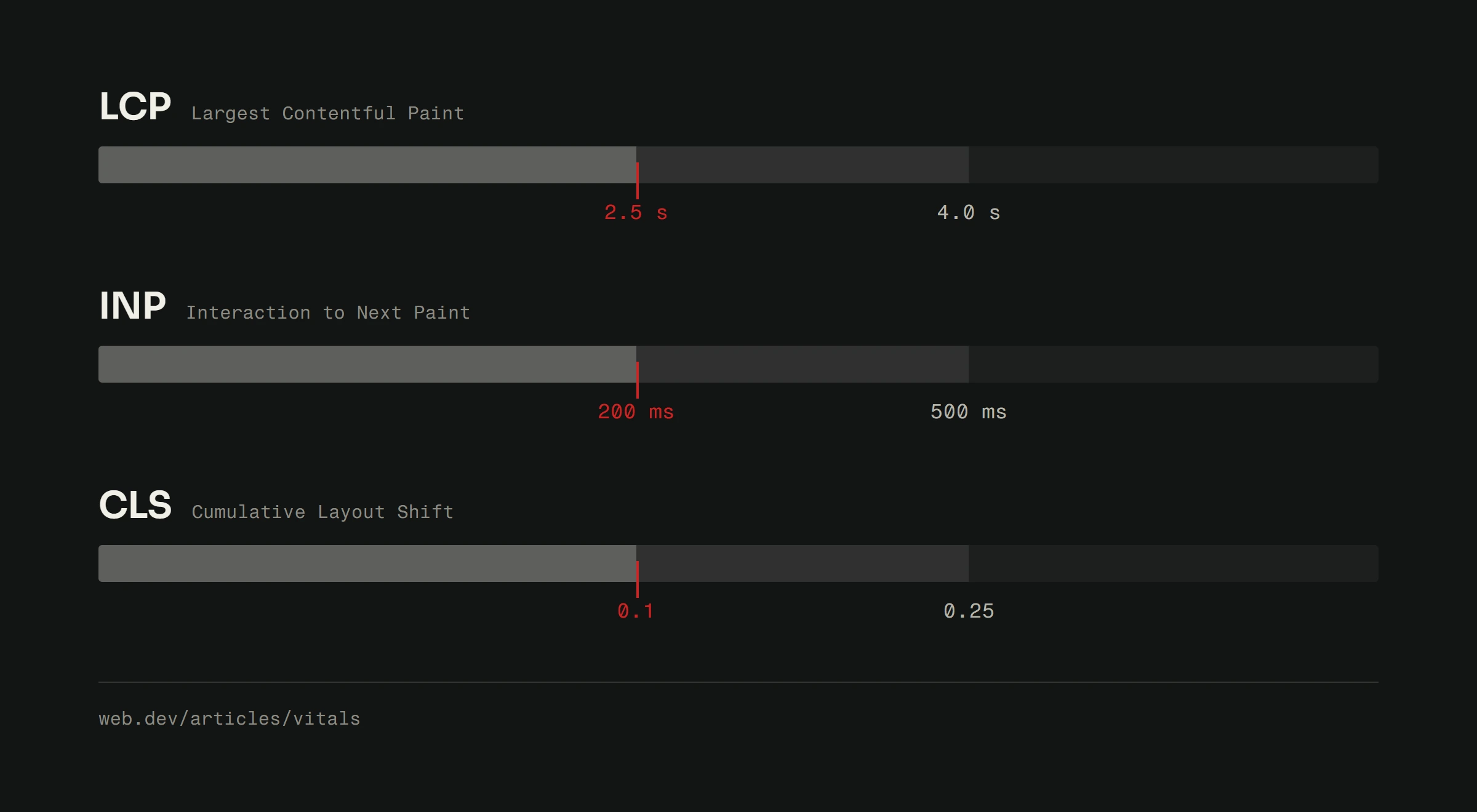
Largest Contentful Paint (LCP) measures how long it takes for the main content of a page to load. Google wants this under 2.5 seconds.

Threshold bands for the three Core Web Vitals: LCP good under 2.5 seconds and poor over 4.0, INP good under 200 milliseconds and poor over 500, CLS good under 0.1 and poor over 0.25.
Speed as Google grades it. One row per metric, and the only question is whether you are left of the crimson line.View full-size image

Interaction to Next Paint (INP) measures how quickly your page responds to user interactions. Google wants this under 200 milliseconds. INP replaced First Input Delay in 2024 because it captures responsiveness more accurately across the entire page lifecycle, not just the first interaction.

Cumulative Layout Shift (CLS) measures visual stability. Those annoying pages where content jumps around as things load? Google penalizes that.

If your site fails these metrics, it will rank lower. Period. You can have the best content in your industry, the most authoritative backlinks, and a perfect keyword strategy. If your site is slow, Google will put a faster competitor above you.

This means speed optimization is SEO. Not a separate concern. Not something the developers handle while the marketing team does SEO. They are the same thing.

Speed and Conversion Are Directly Connected

The link between speed and revenue is not theoretical. It is measurable and well-documented.

Studies consistently show that every additional second of load time drops conversion rates by roughly 7%. For a site generating $100,000 per year, making it one second faster could mean an additional $7,000 annually. Two seconds faster, $14,000. The math is straightforward.

This applies whether "conversion" means a purchase, a form submission, a sign-up, or any other action you want visitors to take. Faster pages produce more actions. Slower pages produce more abandoned sessions.

The reason is simple. Every moment of waiting is a moment where the user can change their mind. A fast site catches people in their moment of intent and moves them through the funnel before doubt creeps in. A slow site creates gaps where doubt lives.

E-commerce sites feel this the hardest. Add-to-cart rates, checkout completion rates, and average order values all correlate with page speed. Converting visitors into customers starts with not losing them to a loading spinner.

Bounce Rate: The Silent Killer

Bounce rate measures the percentage of visitors who leave after viewing only one page. For slow sites, this number is devastating.

A page that loads in one second has an average bounce rate around 7%. At three seconds, that jumps to 11%. At five seconds, it is 38%. At ten seconds, it is 58%. These are averages. For some industries, the numbers are worse.

Every bounced visitor is someone who expressed interest in what you offer. They clicked a link. They typed your URL. They found you in search results. They had intent. And your slow site killed that intent before it could become anything.

High bounce rates also feed back into SEO. Google interprets high bounce rates as a signal that your page did not satisfy the user's query. This pushes you further down in rankings, which reduces traffic, which reduces revenue. It is a downward spiral that starts with slow loading times.

What Actually Makes a Website Slow

Before you can fix the problem, you need to understand the causes. Most slow websites suffer from a combination of these issues.

Unoptimized images. A single hero image can be 3MB if nobody bothered to compress it. Modern formats like WebP and AVIF can cut that by 50-80% with no visible quality loss.

Too much JavaScript. Every script needs to be downloaded, parsed, and executed. Heavy frameworks, analytics scripts, chat widgets, tracking pixels. They all add up. Many sites load over a megabyte of JavaScript before the user can see anything.

No caching strategy. Without proper caching, browsers re-download the same assets on every visit. A returning visitor should load your site almost instantly. If they do not, your caching is broken.

The same page measured twice: transferred bytes fall from 1898 KB to 1 KB and load time from 1854 ms to 549 ms, while the request count only drops from 158 to 156.
The returning visit, measured on one page in one session. The bytes fall from 1898 KB to 1 KB and the load from 1854 ms to 549 ms, but the request count barely moves. Caching removes the download, not the round trip.View full-size image

Slow server response. If your server takes two seconds to respond before the browser even starts rendering, you have already used most of your time budget. Cheap hosting, unoptimized databases, and no CDN are common culprits.

Render-blocking resources. CSS and JavaScript files that block the browser from displaying content until they have loaded. Critical CSS should be inlined. Everything else should be deferred.

We cover fixes for all of these in our guide on how to optimize website speed.

How to Measure Your Site's Speed

You cannot improve what you do not measure. Here are the tools that matter.

Google PageSpeed Insights gives you Core Web Vitals data from real users and a detailed list of issues to fix. It is free and should be your first stop.

WebPageTest lets you test from different locations and connection speeds. It shows a waterfall chart of every request, which helps identify the biggest bottlenecks.

Chrome DevTools has a Performance tab and a Lighthouse audit built in. Great for debugging specific issues during development.

Test on mobile with a throttled connection. Not everyone has fiber internet. Your site needs to be fast on a 4G connection too. The mobile test in PageSpeed Insights simulates this by default.

Speed Is a Competitive Advantage

In a market where most businesses neglect performance, a fast site stands out. Not because users consciously think "wow, this site is fast." But because they do not think about speed at all. They just have a smooth experience and are more likely to trust you, engage with your content, and buy from you.

Your competitors are probably running slow WordPress sites loaded with plugins. They have 4-second load times and think that is normal. It is normal. But normal is not good. Rebuilding a site with clean code and proper optimization can boost speed by 150% or more.

A well-designed website that loads in under two seconds feels premium. It communicates competence. It respects the user's time. And it outperforms slower competitors in every metric that matters: rankings, traffic, engagement, and conversions.

Speed is not a feature. It is the foundation. Build everything else on top of it.


Wondering how fast your site actually is? Start with a free website analysis and we will show you exactly where the bottlenecks are and how to fix them.

Share this article

Related articles

ContactWhatsApp