"We need someone to design our website." Nine times out of ten, what people mean is "we need someone to build our website." They're using "design" as shorthand for the entire process. That's understandable. But if you're hiring someone, the distinction matters.
Web design and web development are two different disciplines. They overlap, they depend on each other, and sometimes the same person does both. But they require different skills, different tools, and different ways of thinking.
Let's sort this out.
What web design actually means
Web design is about how a website looks and feels. It's the visual layer. Colors, typography, spacing, layout, imagery, icons. All the things you notice when you first land on a page.
But design goes deeper than aesthetics. A good web designer isn't just making things pretty. They're solving problems. Where should the most important information go? How should a user navigate from the homepage to a product page? What should the call-to-action buttons look like so people actually click them?
This is user experience (UX) design. It's about making the site intuitive. When someone can use your website without thinking about how to use it, that's good design at work.
Web designers typically work with tools like Figma, which has become the industry standard for collaborative design. Some teams still use Sketch on Mac. They create mockups and prototypes that show what the finished site will look like before any code gets written. They think about how colors influence perception, how typography affects readability, and how visual hierarchy guides attention.
The deliverable from a web designer is usually a set of design files. Pixel-perfect layouts for each page type, a style guide, and specifications that developers use as their blueprint.
What web development actually means
Web development is about how a website works. It's the functional layer. Code, databases, servers, APIs, performance, security.
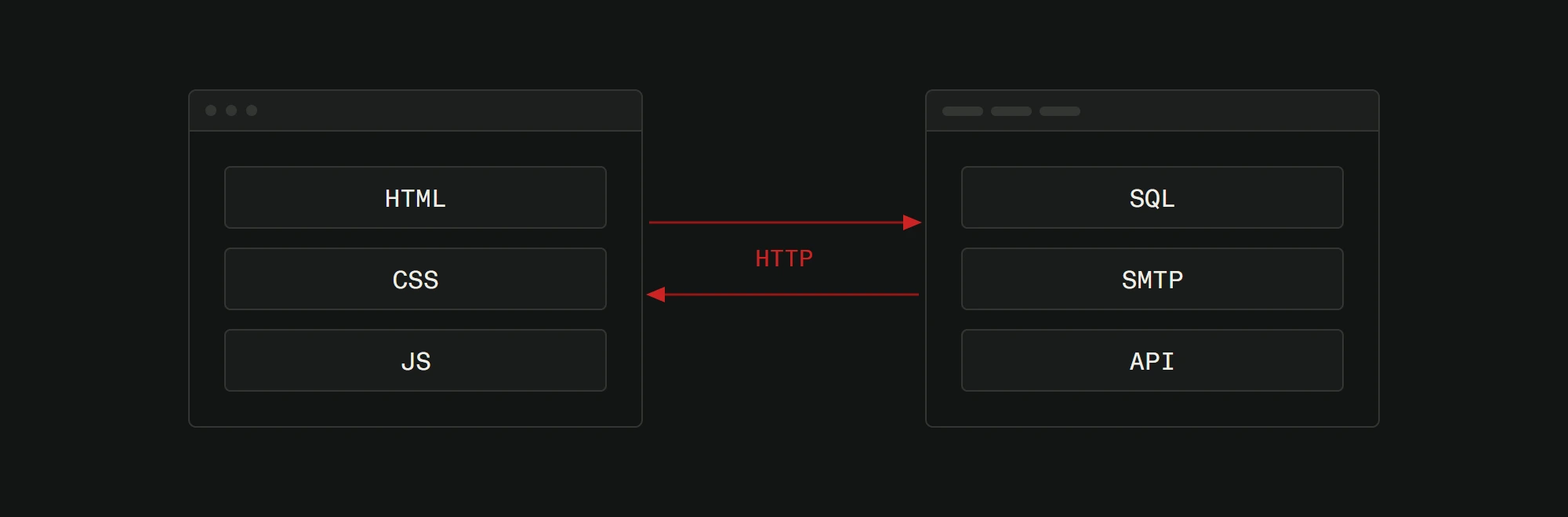
Developers take a design and turn it into a living, breathing website. They write the HTML that structures content, the CSS that styles it, and the JavaScript that makes it interactive. They build the systems that let you update content, process orders, send emails, and handle user accounts.
Development splits into two specializations.
Front-end development is the code that runs in the browser. It's responsible for turning design files into actual web pages. Every animation, dropdown menu, form validation, and responsive layout is front-end work. Front-end developers care deeply about page load speed because every kilobyte of unnecessary code makes the site slower.
Back-end development is the code that runs on the server. It handles data processing, authentication, content management, database operations, and integrations with third-party services. When you submit a contact form and receive a confirmation email, that's back-end logic.
A simple brochure website might need minimal back-end work. An e-commerce site with inventory management, payment processing, and user accounts needs substantial back-end architecture.
Where they overlap
The line between design and development isn't always crisp.
CSS (which styles web pages) lives in both worlds. A designer decides that buttons should be blue with rounded corners. A developer implements that decision in CSS. But the developer also decides how those buttons animate on hover, how they reflow on small screens, and how they handle focus states for keyboard navigation.
Interactive elements blur the boundary further. A designer might sketch a dropdown menu. But the developer determines how it actually opens, how it handles keyboard interaction, what happens on touch devices, and how it performs with 200 menu items instead of 5.
This is why the best web projects involve designers and developers working together, not in sequence but in parallel. Design decisions have technical implications. Technical constraints shape design possibilities.
Why the distinction matters when hiring
If you need a website built from scratch, you need both design and development. Some companies (like us) handle both. Some freelancers specialize in one or the other.
Here's where it gets practical.
If your existing site works fine but looks outdated, you primarily need a designer. The underlying code might be perfectly functional. A visual refresh might be all that's required.
If your site looks great but runs slowly, crashes on mobile, or has broken features, you need a developer. The design isn't the problem.
If you're starting from zero, you need the full web design and development process. Trying to save money by skipping one discipline usually costs more in the long run.
The full-stack reality
You've probably heard the term "full-stack developer." It means someone who handles both front-end and back-end development. Some full-stack developers also have design skills.
These people exist. They can build an entire website solo. But there's a trade-off. Being good at everything is harder than being great at one thing. For small projects, a skilled full-stack person is efficient and cost-effective. For larger projects, specialized roles produce better results.
At a studio level, having dedicated designers and developers means each person brings deep expertise to their domain. The designer isn't distracted by server configuration. The developer isn't second-guessing typography choices. Everyone does what they're best at.
What this means for your project
If you're planning a website, here's the practical takeaway.
Don't skip design and jump straight to development. You'll end up with something that works but doesn't connect with your audience. Design is where strategy meets visuals.
Don't stop at design without proper development. A beautiful mockup that loads slowly, breaks on mobile, or has security vulnerabilities isn't serving your business.
Both disciplines exist for a reason. They're different skills that produce different outputs. Together, they create websites that look right, work right, and actually deliver results.
Need both design and development handled properly? Check out our process and see how we approach projects from concept through launch.