
This guide focuses on implementation: taking one business task from a useful draft to a dependable workflow. A language model is only one part. Source quality, permissions, system connections and the handoff to a person determine how the result can be used.
Chatbots: Your website's 24/7 employee
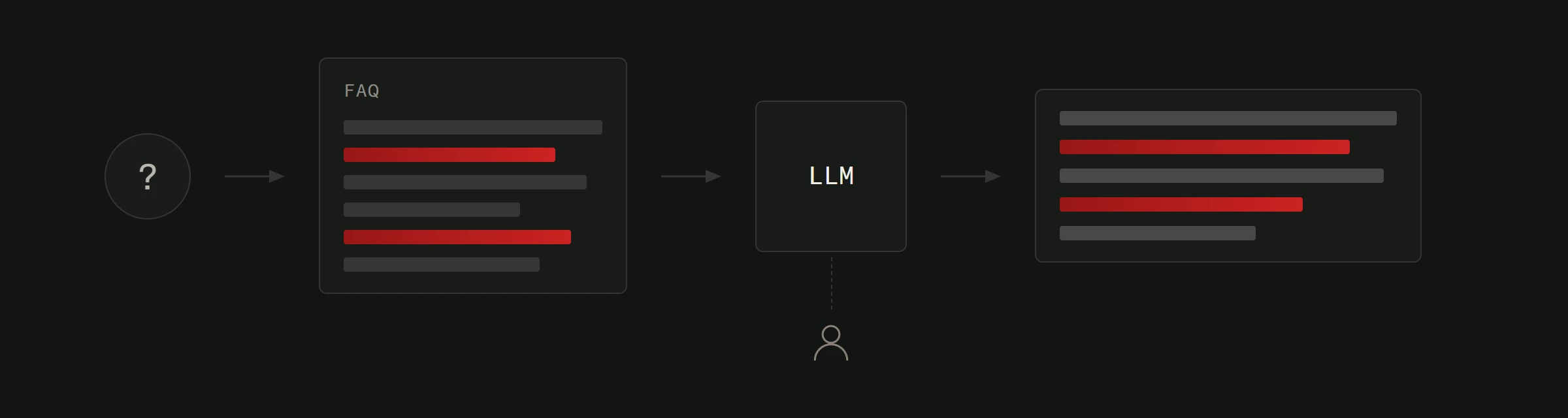
An assistant can answer from approved service information while your team is unavailable. It should state when information is missing and provide a contact route. A booking or quote requires a confirmed result from the relevant system. On our own site, chat, forms and the calculator have distinct roles: a conversational answer is not a completed order. The broader AI guide helps decide whether an assistant is the right first task.
Content generation: The first draft machine
Give the system a bounded source and a clear format, such as a draft reply with its supporting document section. Review names, figures, links and commitments before publication. A fluent draft may contain invented details. Keep real case studies tied to the actual project record; a model must not fill missing results with plausible numbers. Source review and editing remain part of the workload.
Customer understanding: Patterns you'd never see
Start with categories people can verify, such as the service requested or whether an enquiry contains the needed contact details. Compare the extracted fields against the original message. Predictions about customer value or future purchases require suitable data and separate evaluation. The presence of an AI feature does not establish that those predictions are accurate.
Personalization: The right message to the right person
A relevant page and a clear offer can be useful without individual tracking. If you introduce recommendations or segmentation, define the data and permission needed for that use. Compare the result with a simpler baseline. Do not assume a personalized experience is always clearer or more effective; make that a testable question.
Automation: Doing the boring stuff automatically
Use deterministic rules for actions with a known condition: a form received, an order paid or a reminder due. Add model interpretation where the input is genuinely variable, such as understanding an enquiry. A proposed action should pass validation and access checks before it reaches an external system. Retries must not create duplicate leads or bookings. Our AI integrations describe this boundary between preparation and action.
What AI cannot replace
Assign an owner who can correct source documents, review disputed answers and pause a workflow. Test ordinary successes as well as refusals, missing information and tool failures. Correctly declining an unsafe request does not prove that a legitimate booking works. The real success path must be tested from input to confirmed result.
The privacy dimension
Use only the records needed for the agreed task. Separate public, internal and restricted sources, and enforce access outside the model's instructions. Avoid sending personal information to providers without an approved purpose and arrangement. Review the actual data flow and applicable obligations before launch. A demonstration on sample records does not establish readiness for customer data.
Where to start if you're new to this
Choose a small pilot and write acceptance criteria before implementation: correct output, review time, failed cases and operating cost. Keep a baseline and a rollback. Then decide whether to extend, revise or stop the pilot using its results. The AI-readiness check, training and integration pricing provide different starting points depending on what your team needs.