AI and Digital Marketing: What's Real, What's Hype

Forget the buzzwords. Here's what AI is actually changing about digital marketing, what still requires a human, and where your business fits in.

Every marketing article right now starts with some version of "AI is revolutionizing everything." Most of them are written by people who've never actually implemented AI for a real business. Let's skip the hype and talk about what's genuinely different.

The Shift: From Guessing to Knowing

The biggest change AI brings to marketing isn't flashy. It's boring. And that's why it works.

Before AI, marketing decisions were based on gut feelings, broad demographics, and monthly reports that were already outdated by the time you read them. Now you can analyze customer behavior in real time and adjust on the fly.

A small e-commerce store used to send the same newsletter to everyone on their list. Now AI segments that list automatically. People who browse shoes get shoe promotions. People who buy every month get loyalty offers. People who haven't visited in 60 days get a reactivation email. Same tool, same list, completely different results.

This isn't sci-fi. This is available right now with tools most businesses already have access to.

What AI Actually Does Well in Marketing

Let's be specific. AI is genuinely useful for these things.

Pattern recognition at scale. Humans can't read 10,000 customer interactions and spot trends. AI does it before your morning coffee. It finds which pages lead to conversions, which email subject lines get opens, and which customer segments are about to churn.

Personalization that works. Not the creepy "we know what you did last summer" kind. The useful kind. Showing relevant products. Adjusting website content based on visitor behavior. Recommending the right blog post based on what someone read before. For more on how this works in practice, see our guide to AI's role in digital marketing.

Automation of repetitive tasks. Scheduling posts. Sorting leads. Sending follow-up emails. Tagging customer support tickets. These are hours of human work that AI handles in the background without complaint.

Content generation as a starting point. AI writes decent first drafts. It generates ad variations for testing. It rephrases the same message for different platforms. It's not replacing writers. It's replacing the blank page. If you're curious about using ChatGPT specifically, here's our practical guide to ChatGPT for business.

What AI Still Can't Do

This part matters just as much.

Strategy. AI can tell you what happened. It can predict what might happen. It cannot decide what your business should stand for or which market to pursue. That's still a human job.

Brand voice. AI can mimic tone. It cannot create the personality that makes your brand memorable. The quirks, the opinions, the willingness to say something nobody else will. That comes from people.

Relationship building. A chatbot handles FAQ questions brilliantly. It does not build the kind of trust that makes a client refer you to their friends. Human connection still matters.

Judgment calls. Should you respond to that negative review? Should you pivot your campaign because of a cultural moment? AI gives you data. Humans make the call.

Where Small Businesses Should Start

You don't need a massive budget or a data science team. Start with what's practical.

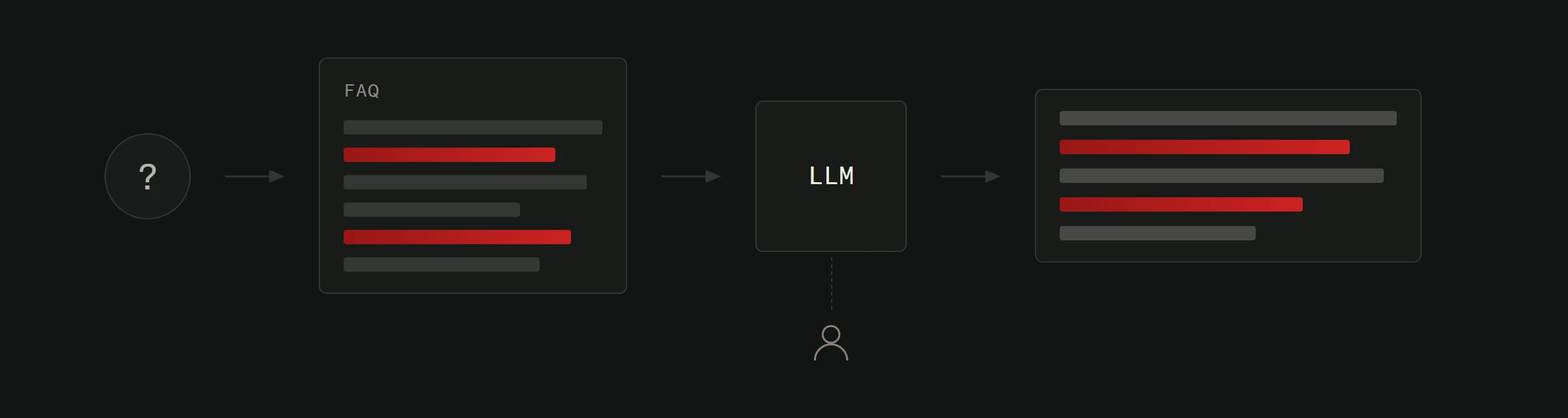
Add a chatbot to your website. Not a complicated one. Just something that answers the five questions every visitor asks. Pricing, availability, location, process, and timeline. This alone reduces response time from hours to seconds. Check out our AI integration services for help with this.

A left to right path. A question mark in a circle, an arrow into a box labelled FAQ holding six rows of text of which two are highlighted in crimson, an arrow into a square box labelled LLM, and an arrow into an answer box of five lines of which two are crimson. A dashed line drops from the LLM box to a drawn figure of a person.
Why the simple version is the one that works. Five written answers are the whole middle box, and everything the model adds is phrasing on top of them. Complicated builds fail at the same step simple ones do, which is not having the answers written down.View full-size image

Use AI for content creation. Not to replace your writing, but to speed it up. Generate outlines, first drafts, and variations. Edit them with your voice and expertise. A single blog post that used to take three hours now takes one.

Let AI handle your email segmentation. Most email platforms already have AI built in. Turn it on. Let it segment your audience based on behavior instead of manually creating groups.

Analyze your website data with AI tools. Google Analytics already uses machine learning. Learn to read its AI-generated insights. They'll tell you things about your visitors you never thought to look for. Our free website analysis can show you where your site stands.

The Privacy Question

This matters and too many AI articles skip it.

Every AI marketing tool runs on data. Customer data. If you're collecting it, you need consent. GDPR isn't optional and it isn't just a checkbox. Be transparent about what data you collect, why you collect it, and how long you keep it.

On top of GDPR, the EU AI Act is now in effect, with the majority of its rules applying from August 2026. If you use AI chatbots on your website, you'll need to disclose that visitors are interacting with an AI system. If you use AI to generate marketing content, transparency obligations apply in certain contexts. These aren't burdensome requirements for most small businesses, but they're worth knowing about.

A timeline of Regulation (EU) 2024/1689 with five marks spaced by real elapsed months: 2024-08-01 entry into force, 2025-02-02 for Articles 4 and 5, 2025-08-02 for Article 53, 2026-08-02 for Article 50 highlighted in crimson, and 2027-08-02 for Article 6(1).
Why the majority of the rules land on one day. The Regulation entered into force in 2024 and switches on in stages, with chatbot disclosure in the 2026 block.View full-size image

The good news: being privacy-conscious is actually a competitive advantage. Customers trust businesses that are honest about data usage. The ones who try to collect everything secretly are the ones who lose trust.

The Real Competitive Advantage

Here's what most people miss. The advantage isn't the AI itself. Everyone has access to the same tools. The advantage is implementation speed and quality.

Two businesses use the same chatbot platform. One configures it properly, trains it on their actual FAQ, and monitors its conversations weekly. The other installs it with default settings and forgets about it. Same tool. Completely different outcomes.

The businesses winning with AI aren't using secret technology. They're implementing the available technology thoughtfully. They're testing, measuring, and adjusting. They're treating AI as a tool, not a magic wand.

What Happens If You Wait

Marketing is getting more personalized, more automated, and more data-driven every quarter. The businesses adopting AI now are building systems that compound over time. Their chatbots get smarter. Their email segmentation gets tighter. Their content machine gets faster.

Waiting doesn't mean you'll catch up later. It means the gap gets wider.

You don't need to do everything at once. But doing nothing is a choice that costs more each month.


Ready to put AI to work for your marketing? Start with our beginner's guide to ChatGPT or explore how Version2 handles AI integration for businesses like yours.

Share this article

Related articles

ContactWhatsApp