Every year, someone publishes a list of "top SEO trends" that reads like a tech buzzword bingo card. Most of it is noise, and some of it is bad advice.
The trends that matter in SEO optimization are rarely the flashy ones. They're quiet shifts in how Google decides who gets traffic. This overview separates what really changed in 2025 and 2026 from what you can safely skip.
What's actually new in SEO technology in 2025 and 2026
The biggest change is that Google increasingly answers on its own. According to Google's help pages, AI Overviews, the AI-written summaries at the top of the results, are available in many countries and languages, Croatia, Germany and Austria among them. AI Mode, a search mode in which AI writes the whole answer and links to its sources, is also available, Croatian included.
For site owners, Google is clear: there are no additional requirements and no special optimization for appearing in those answers. A page must be indexed and eligible to show a snippet in ordinary search, and the same fundamentals apply as before. Search Console counts visits from those answers in the Performance report, under the Web search type, together with the rest of your search traffic.
The third thing worth watching is Google's updates. Since the start of 2025, Google has started five core ranking updates and five spam updates; the exact dates are in our article on Core Web Vitals and ranking on Google. When your positions change suddenly, first check whether the date matches one of them.
AI Overviews changed the game
For many informational queries the answer now sits on the results page itself. For generic content that only repeats what's already known, that can mean fewer clicks.
What does this mean for your site? Two things.
First, it pays to be the source that gets cited. That means specific, verifiable, well-structured content: real data, real experience, a clear position. A 500-word post that says nothing new has no reason to be cited.
Second, commercial and transactional queries still lead to websites. Someone searching "best CRM for small businesses" still wants to compare the options themselves. Point your content at queries where people need more than a summary.
Search intent is everything
Google understands what people actually want very well, not just the words they type.
A search for "web design" might mean someone wants to learn about it, hire someone or find a tool to do it themselves. Google shows different results for each of those meanings.
That's why keyword research isn't only about search volume anymore. Look at the actual results for the terms you care about. What shows up: product pages, blog posts, videos? Offer the format Google already shows.
One page that tries to rank for everything rarely ranks for anything.
E-E-A-T isn't just a buzzword
Experience, expertise, authoritativeness and trustworthiness (E-E-A-T) is how Google describes the content it wants to show. According to its documentation, E-E-A-T isn't itself a specific ranking factor, but its systems use a mix of signals that identify such content. Trust matters most, and it carries extra weight on topics that affect people's health, finances or safety. Google's quality raters don't set positions: their ratings help Google check whether its systems work well.
Here's what E-E-A-T looks like in practice:
- Experience: Show that you've actually done what you're writing about. Screenshots, project write-ups, concrete numbers from your own work.
- Expertise: Who writes matters. Named authors and what they know give content weight.
- Authoritativeness: Other sites link to you because your content is worth citing. Backlinks remain an important signal.
- Trustworthiness: HTTPS, clear contact details, privacy policies, accurate content. The basics.
Content with no author and no real knowledge behind it starts from a weaker position.
Content written with AI
Publishing hundreds of articles is easy now. Google's spam policies have an answer to that: publishing content at scale whose main purpose is to manipulate rankings rather than help people breaks the rules, no matter how it was created. Google explicitly gives the example of using generative AI tools to create many pages that add no value for users.
That doesn't mean AI is forbidden. It means the result is what's measured: does the page add something a reader wouldn't get elsewhere? Ten verified articles from your own experience are worth more than a hundred generic ones.
Core Web Vitals remain the baseline
Page speed isn't a trend. It's a basic requirement.
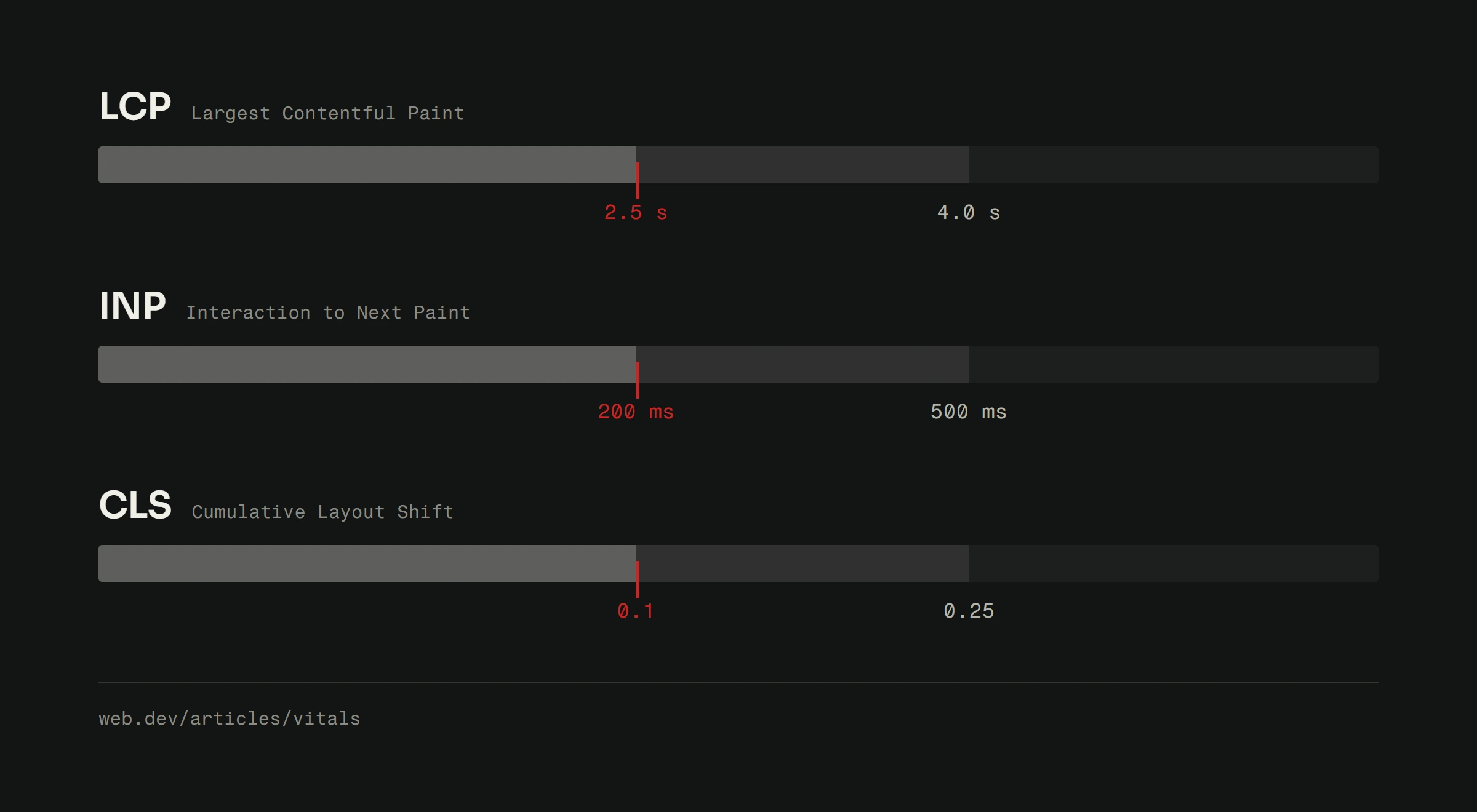
Since March 2024, Core Web Vitals include Interaction to Next Paint (INP), which replaced First Input Delay. INP measures how quickly a page responds to every interaction, not just the first, so JavaScript-heavy sites feel it most.
A short checklist for site speed optimization:
- LCP (Largest Contentful Paint): Under 2.5 seconds. Optimize hero images, preload key resources, use a CDN.
- INP (Interaction to Next Paint): Under 200 ms. Reduce JavaScript, break up long tasks, defer scripts that aren't essential.
- CLS (Cumulative Layout Shift): Under 0.1. Set dimensions on images and ads. No sudden shifts.
Test with PageSpeed Insights. Fix the red items first, then the orange ones. How much these metrics really affect your position is explained in our article on Core Web Vitals.
Zero-click searches are growing
Featured snippets, knowledge panels, "People also ask" boxes and AI Overviews answer the question on the results page itself. Some people then don't click anywhere. You can prepare for that.
Write so that Google can cite you. Structure content with clear H2 and H3 headings, answer the question directly in the first paragraph under the heading, and use lists and tables where they genuinely help.
Build recognition for your name too. Someone who sees your name in the answers again and again starts searching for you directly.
Mobile performance is non-negotiable
Google indexes the mobile version of your site. Your mobile site is your site.
It isn't only about responsive design, but about whether someone on a phone can actually do what they came for. Is the text readable without zooming? Are buttons big enough to tap? Does the menu work with one hand?
The Mobile Usability report in Search Console and Google's Mobile-Friendly Test were retired on 1 December 2023. So check your mobile version with Lighthouse in Chrome and, above all, on real phones.
Trends you can safely ignore
Not every novelty deserves your attention. Here's what we'd skip:
- Voice search as a separate strategy. If you write clearly and answer questions directly, you've already covered voice queries.
- Special "AI optimization". Google says there are no additional requirements for AI Overviews and AI Mode. What works for ordinary search works there too.
- Chasing every algorithm update. If your content is genuinely useful and your technical foundation is sound, a single update is rarely a reason to panic.
- Social media as a ranking factor. Google doesn't list it among its ranking signals. It can bring visits and links, but that's an indirect effect.
What actually works
Once you set the trend talk aside, sites that rank well for years do the same things.
They publish content that genuinely helps their audience and build it on a technically sound foundation. They earn quality backlinks from relevant sites. They keep their Google Business Profile up to date. They measure what works and do more of it.
There's no secret hack and no magic trend. There's consistent, good work over a long time.
The best SEO strategy is the one you actually carry out. Pick what fits your resources and your audience, and ignore the rest.
Not sure which SEO priority would help your site most? Our free website analysis will show you where to start.