
Your business is great. Your neighbors just can't find it online. That's a local SEO problem, and it's fixable.
Local SEO is how you show up when someone nearby searches for what you do. Not globally. Not nationally. Right here, in your city, your neighborhood. Get it right and you become the obvious choice. Get it wrong and the business down the street takes your customers.
Here are 10 strategies that actually work.
1. Claim and optimize your Google Business Profile
This is step zero. If you haven't claimed your Google Business Profile (formerly Google My Business), nothing else on this list matters.
Fill out every single field. Business hours, services, categories, attributes. Add real photos of your location, your team, your work. Not stock images. Google rewards completeness, and users reward authenticity.
A fully optimized profile increases your chances of appearing in the local 3-pack. That's the box of three businesses that shows up above organic results for local searches. That's prime real estate. For a deeper dive, check out our guide to Google My Business.

2. Get reviews and actually respond to them
Reviews are social proof and a ranking signal. Both matter.
Ask happy customers to leave a Google review. Make it easy by sending them a direct link. Then respond to every single review. Yes, even the negative ones. Especially the negative ones. A thoughtful response to criticism shows potential customers you care. A defensive response does the opposite.
The pattern Google wants to see: a steady stream of authentic reviews with engaged business responses. Not 50 reviews in one week followed by six months of silence.
3. Nail your NAP consistency
NAP stands for Name, Address, Phone number. It needs to be identical everywhere your business appears online. Not "mostly the same." Identical.
Check your website, Google Business Profile, Facebook page, Yelp listing, industry directories. If your street address says "St." in one place and "Street" in another, that's an inconsistency. It sounds trivial. Google doesn't think so.
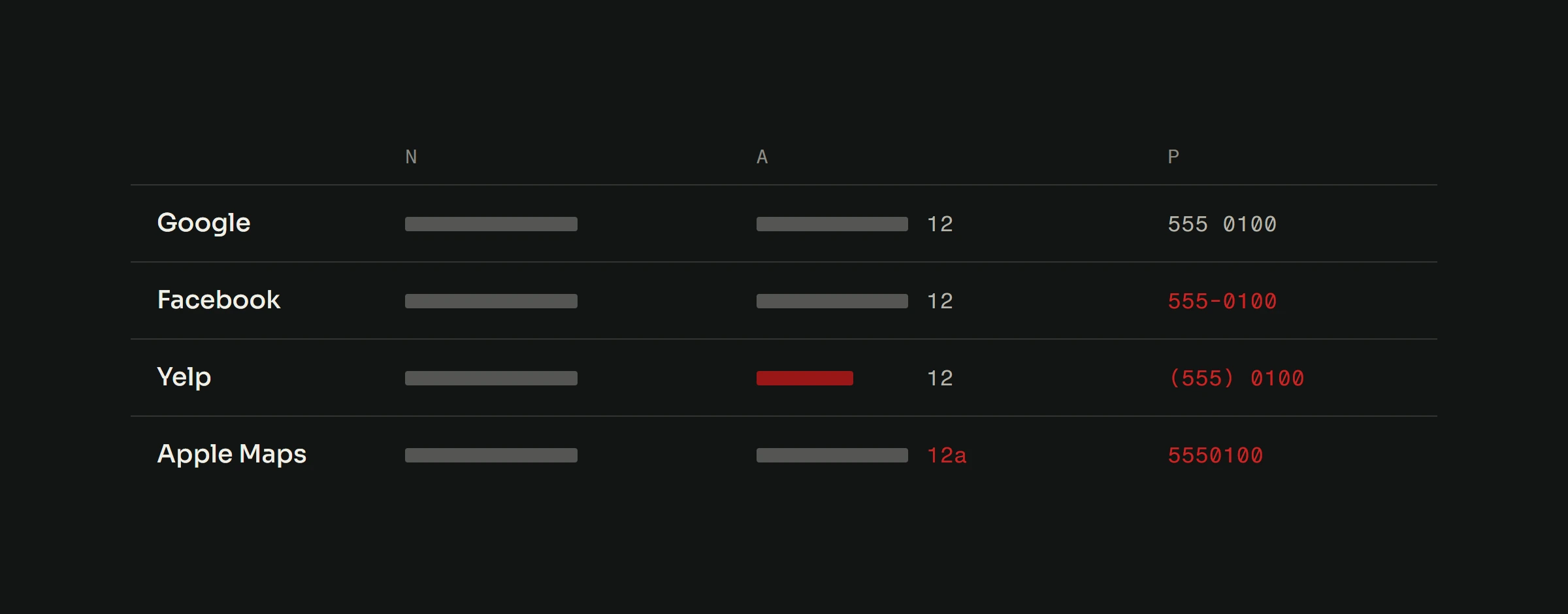
Use a spreadsheet to audit every listing. Fix mismatches immediately.
4. Build local backlinks with purpose
Backlinks from local sources are gold for local SEO. A link from your city's news site carries more local relevance than a link from a random blog across the globe.
How to get them: sponsor a local event. Partner with neighboring businesses for cross-promotions. Contribute a guest article to a local publication. Join your chamber of commerce. These aren't just marketing tactics. They're community involvement that happens to produce great backlinks.
Quality over quantity. One link from a respected local news outlet beats 100 links from irrelevant directories. Read more about building backlinks effectively.
5. Create content about your area
Writing blog posts about local events, neighborhood guides, or area-specific tips does two things. It signals to Google that you're locally relevant. And it gives local readers a reason to visit your site.
A restaurant in Zadar writing about the best sunset spots in town. A web development company writing about the local business scene. A gym writing about running routes in the area. This kind of content builds local authority naturally.
Don't force it. Write about things that genuinely connect your business to your community. For the broader picture on site-level improvements, our guide on how to improve SEO on your website covers the fundamentals that apply to both local and general search.
6. Make your site fast on mobile
Over 60% of local searches happen on phones. Someone is walking down the street, searching "coffee near me," and your site takes 5 seconds to load. They've already clicked your competitor.
Test your site with Google PageSpeed Insights. Compress images. Eliminate unnecessary scripts. Make buttons easy to tap. Make text readable without zooming.
Google uses mobile-first indexing, meaning it primarily uses the mobile version of your site for ranking. A slow mobile experience doesn't just frustrate users. It tanks your rankings. For more on this, see our guide to website speed optimization.
7. Use location-specific keywords
"Web design" is a keyword. "Web design Zadar" is a local keyword. The difference in intent is massive.
Research what terms people in your area actually search for. Google's Keyword Planner works for this. Include city names, neighborhood names, and regional terms naturally in your page titles, headings, meta descriptions, and body text.
Don't stuff keywords. Write naturally. But make sure Google knows where you are and what you do. Our keyword research guide covers this in detail.
8. Get listed in relevant directories
Beyond Google Business Profile, make sure you're in the directories that matter for your industry and location. Yelp, Bing Places, Apple Maps, TripAdvisor (if relevant), and any industry-specific directories.
The key word is "relevant." Don't spam every directory on the internet. Pick the ones your potential customers actually use. And again, keep that NAP information consistent across all of them.
9. Engage in local online communities
Facebook groups, local forums, Reddit communities for your city. These are places where your potential customers hang out.
Don't show up just to promote your business. That's obvious and annoying. Show up to be helpful. Answer questions in your area of expertise. Share useful information. Be a real member of the community. When people see you consistently being helpful, they remember your name when they need your services.
This isn't a direct ranking factor, but it drives brand awareness, referral traffic, and the kind of word-of-mouth that eventually turns into reviews and backlinks.
10. Track what's working and cut what isn't
Doing local SEO without tracking results is like exercising without ever stepping on a scale. You might be making progress. You might be wasting your time. You won't know.
Set up Google Analytics and Google Search Console. Monitor which keywords bring traffic. Track which pages convert visitors into customers. Check your local pack rankings monthly.
When something works, double down. When something doesn't, stop doing it. Local SEO isn't a one-time project. It's an ongoing practice that rewards consistency and punishes neglect.
The real secret to local SEO
There's no hack. No shortcut. The businesses that dominate local search are the ones that show up consistently. They keep their information accurate, publish useful content, collect genuine reviews, and build real relationships in their community.
The good news? Most of your local competitors aren't doing any of this. Which means even moderate effort puts you ahead. And as local search evolves alongside the rest of the industry, understanding SEO optimization for the new era keeps your strategy from going stale. If you are looking for a web team in Zadar or anywhere in Croatia, local SEO should be part of the conversation from day one.
Want to know where your site stands? We offer a free website analysis that shows you exactly what's working, what's broken, and what to fix first.